
How Opportunity@Work Uses Coach to Support STARs
Embedded, AI-powered career guidance on TearThePaperCeiling.org
Opportunity@Work is dedicated to unlocking opportunity for more than 70 million workers in the U.S. who are held back simply because they built their skills outside a bachelor’s degree—workers Skilled Through Alternative Routes (STARs). In 2022, Opportunity@Work launched Tear the Paper Ceiling (TTPC), a national campaign to tear down degree requirements and rewire the labor market so all workers are valued for their skills, not just their credentials.
As TTPC gained traction, thousands of STARs began visiting TearThePaperCeiling.org, often at moments of uncertainty and high stakes: after a layoff, in search of higher wages, or when feeling stuck in a long-tenured role. Many arrived asking broad questions about what to do next but had no structured, personalized support to help them translate inspiration into concrete career plans.
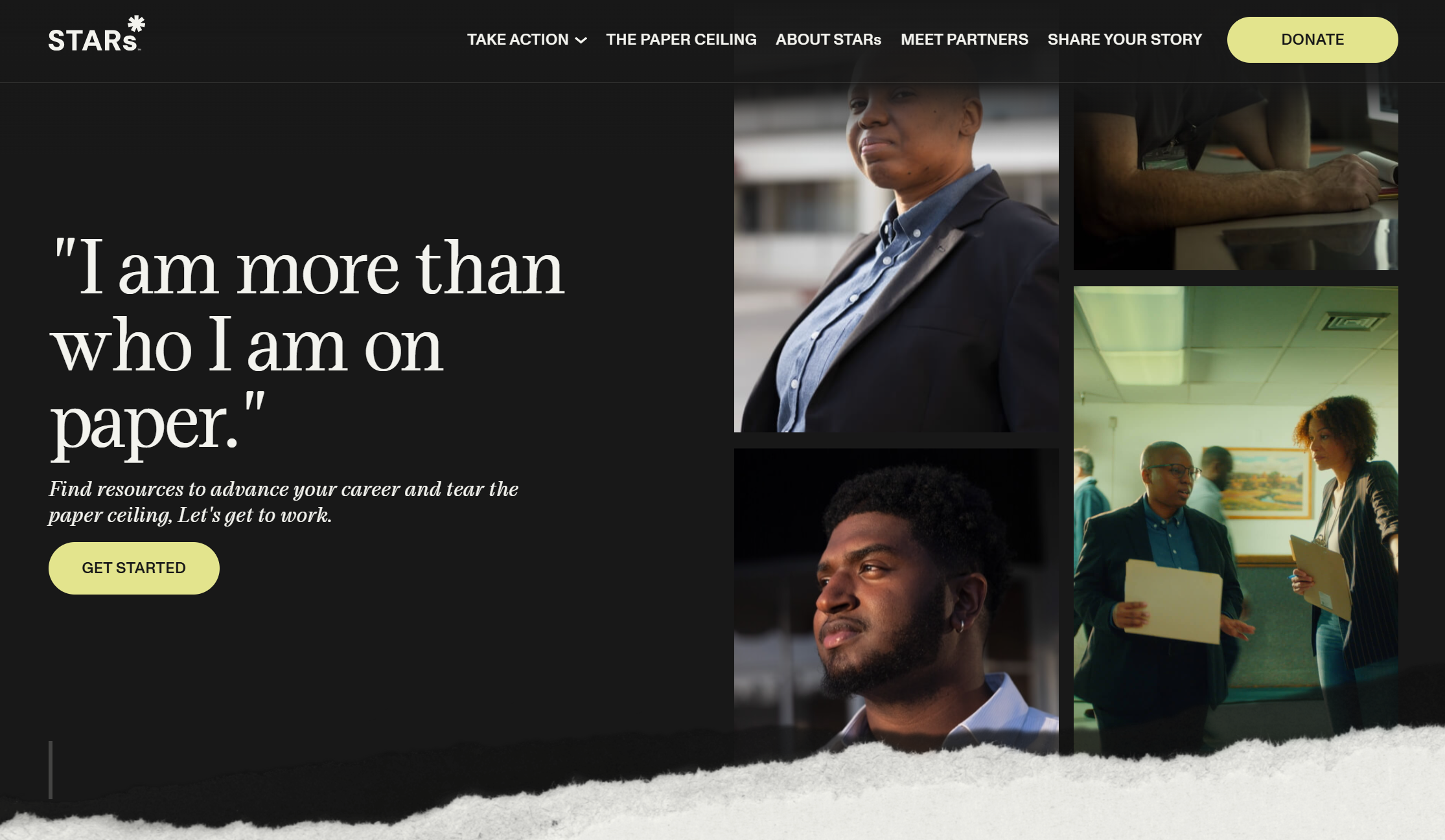
Tear the Paper Ceiling website for STARs
Opportunity@Work wanted a way to offer skills-first, real-time guidance to STARs directly on the TTPC site, without adding staff capacity and without sending visitors away to unvetted, external tools.
Embedding Coach on TearThePaperCeiling.org
Opportunity@Work partnered with CareerVillage.org to bring Coach, the AI-powered career coach, directly into the TTPC experience as a fully branded, embedded widget.
Together, the teams co-developed the TTPC Coach Widget, designed to:
Meet STARs where they are at the exact moment they are thinking about their next move.
Deliver relevant, personalized guidance that recognizes STARs’ skills and lived experience rather than focusing on degrees.
Keep users on the TTPC site, reinforcing Opportunity@Work’s message while providing immediate, practical support.
During the planning phase, CareerVillage.org provided API documentation, UX mockups, and measurement plans, while Opportunity@Work led beta strategy, marketing rollout, and analytics setup. This ensured the experience aligned with TTPC’s mission, language, and goals from day one.
Once the widget was ready for deployment, Coach launched on TearThePaperCeiling.org with:
Co-branded UX that felt native to TTPC
Shared analytics monitoring
Ongoing technical support
Iterative feedback loops to continuously improve the experience for STARs
With a single click, TTPC visitors can now open Coach and begin a structured conversation about their skills, options, and next steps, without leaving the site.
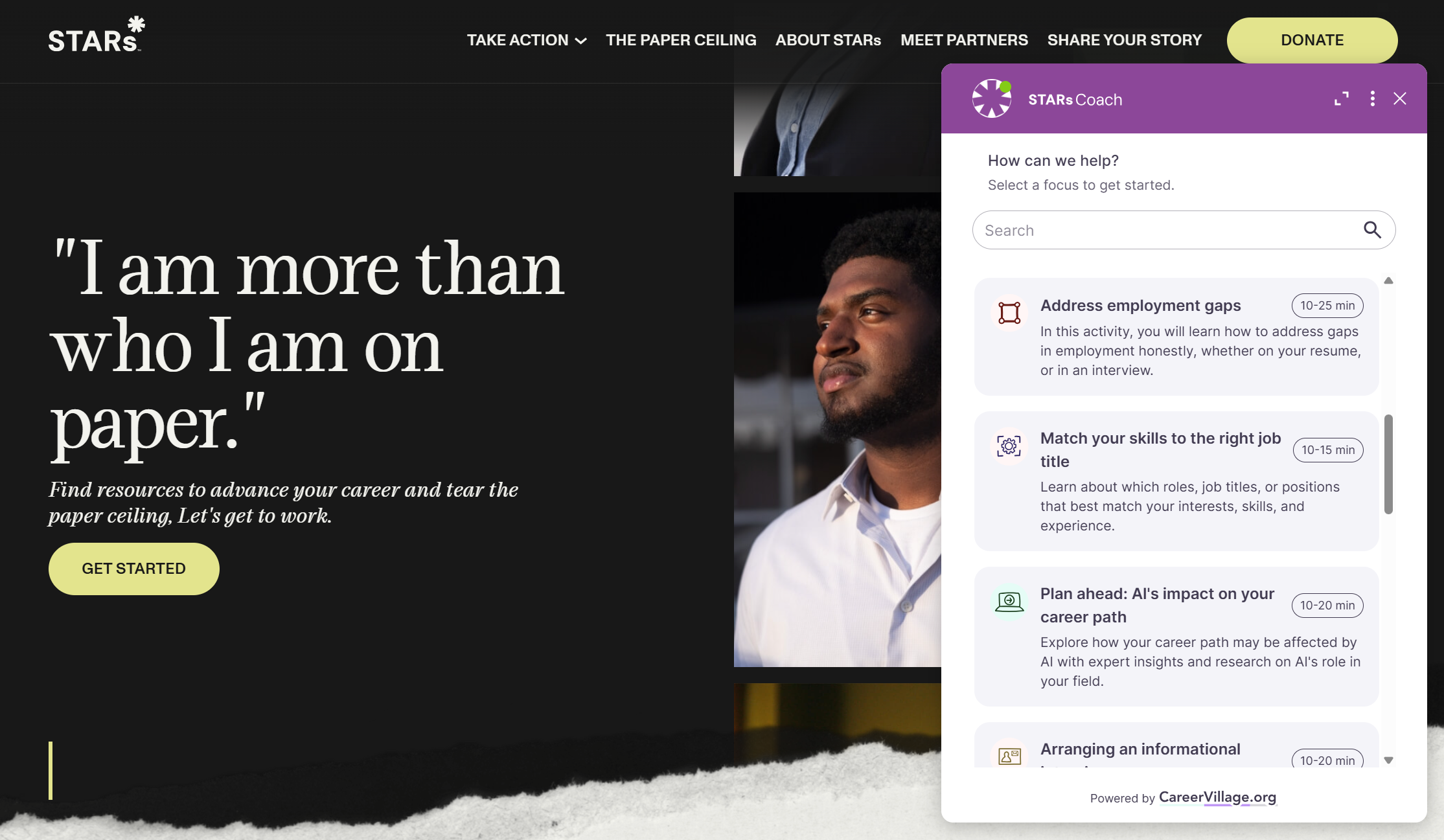
Expanded Coach widget showing the activity menu on the Tear the Paper Ceiling website
Impact at a glance
Over the first eight months after launch, the TTPC Coach Widget was piloted on TearThePaperCeiling.org and:
Supported nearly 800 in-depth coaching conversations with STARs
Engaged hundreds of unique visitors during an early-stage rollout
Earned 100% positive ratings among users who chose to complete the post-chat survey
A separate analysis of Coach conversations on TTPC from January-October found that users consistently described the guidance as helpful, informative, and well-structured.
Usage spanned much of the United States, with the largest cohorts of users coming from California, New York, Texas, Maryland, and Illinois, regions with sizeable STARs populations.
What STARs asked for
Across hundreds of conversations, STARs’ needs on TTPC fell into three primary categories:
Career exploration & transition
Many STARs were navigating transitions such as job loss, stagnant roles, or a desire for higher wages and more fulfilling work.Skill development & transferability
Users frequently asked how to translate experience (e.g., as an auto mechanic, military manager, homeschool parent, or talent acquisition specialist) into new roles or industries.Job search & application support
Users sought practical help: where to find openings, how to tailor resumes, how to follow up after interviews, and how to stand out.
These themes mirror Opportunity@Work’s own research on STARs’ systemic barriers: they are rich in skills and experience but often lack access to tailored guidance that connects those skills to quality opportunities.

Coach is optimized for mobile use, so STARs have access wherever they are
From confusion to concrete action
The TTPC conversation analysis showed a consistent progression from broad uncertainty to specific, actionable next steps:
Initial phase: Users began with general requests like “find a career,” “I need a better job,” or “I’m not sure what to do.”
Mid-phase: They narrowed toward preferences: higher wages, particular industries (e.g., IT, construction, creative fields), or work arrangements (e.g., remote).
Final phase: They asked for specific actions: job titles to pursue, local employers to research, job boards to use, salary ranges to target, and credentials worth earning.
Coach consistently shifted from general guidance to tactical, step-by-step support as users’ questions became more focused, helping STARs leave each conversation with clearer direction and practical next steps.
Stories from the TTPC Coach widget
A few examples illustrate how STARs used Coach to turn uncertainty into action:

Re-energizing a 20-year career
One STAR shared, "I've been in my career for over 20 years and stuck." Coach recognized the desire to "shine like a star" and outlined four concrete strategies for them to consider: skills enhancement, networking and mentorship, shifting career focus, and exploring entrepreneurship. When the user chose to focus on a career shift, Coach provided a step-by-step plan to assess interests, identify transferable skills, research new paths, learn from others, and pilot new roles through projects or volunteering.

Navigating second-chance employment and local labor markets
In Memphis, a user with a past criminal charge wanted to work as a caregiver. Coach provided local wage data for home health aides in the Memphis metro area, explained the career outlook, and offered a practical set of next steps for finding agencies and employers to contact, while being transparent about the limits of its ability to list real-time openings.

Finding a remote project management role
A user with a project management certificate and experience in event and hospitality operations wanted to move into remote work. Coach helped them focus on remote project management roles and provided a structured list of resources including remote-first job boards, general job platforms, company career pages, and freelance marketplaces, so they could begin a targeted search aligned with their skills and work preferences.
In each case, the conversation progressed from a broad concern to a focused set of roles, resources, and actions, reinforcing TTPC’s message that STARs’ skills are valuable and portable.
Takeaways for Institutions
For workforce organizations, higher education institutions, and other platforms serving adult learners and job seekers, the TTPC experience surfaces a few design principles to keep in mind as you evaluate or implement any career coaching or navigation tools.
When you think about bringing these tools into your ecosystem, it can be helpful to ask:
Are we meeting learners at the moment of need?
The most effective tools show up where learners already are (campaign sites, portals, LMSs, resource hubs) so support is available at the exact moment someone is searching, scrolling, or asking “what do I do next?”, rather than on a separate, unvetted site.Does this move learners from confusion to concrete action?
Beyond answering questions, look for tools that help people progress from “I’m stuck” to specific roles, skills to build, employers to research, and steps to take in the next week. The value is in that progression, not just in chat volume.Is guidance grounded in local labor markets?
Many learners need to understand what opportunity looks like in their city or region. Prioritize solutions that can reflect local wage ranges, example employers, and realistic role options in the places you serve.Does this extend, rather than replace, human advising?
Career tools should handle common questions and early-stage exploration so staff can focus on higher-stakes, more complex cases. Look for options that complement your advising model and, where possible, make it easy to share insights or transcripts with staff when a handoff is needed.Can we implement and govern this with reasonable lift?
Embedded or integrated tools should be straightforward for IT and program teams to stand up, respect your data privacy and security standards, and provide clear analytics so you can understand who is using them, when, and for what.
The TTPC pilot offers one example of how these principles can play out in practice. As you consider your own mix of tools, whether AI-powered coaching, resource hubs, or other digital supports, these questions can help ensure that new solutions genuinely advance your goals for equity, access, and outcomes.

When you think about your standard support services, such as how to build a resume or prepare for your job interviews, any career coach or guidance counselor can offer that. But Coach also provides market insights, including the pay scale for certain roles. Being able to provide that information in real time to STARs can help boost their confidence.

Join the Conversation
CareerVillage.org is committed to working alongside educators, workforce leaders, and career development experts to refine and scale AI-powered career coaching and support.
Let’s connect and shape the future of career navigation together.