How do we know whether these tools are good? (February 2026)
Sign up here to get Career Futures in your inbox.
Welcome to the February edition of the Career Futures newsletter.
How do we know whether these tools are good?
It’s no secret that career guidance has always had a scaling problem. High school counselor-to-student ratios hover around 1:376 nationally, and that counselor is handling so many things beyond career guidance: academic planning, mental health support, and college admissions, just to name a few. In higher education, the ratio is even more lopsided, with just a handful of career service staffers often serving thousands or tens of thousands of students. For adult learners and job seekers outside of institutions, the options vary widely, and often come down to what you can find on the internet.
AI seems to solve this. Adoption is moving quickly, tools are proliferating, and there's growing evidence that career guidance is one of the things people actually want to use AI for. If the goal is simply to make career support, any kind of career support, available to more people, then mission accomplished!
Of course, availability isn’t the whole story. While the promise of utilizing AI to scale career support is real, there is still a long way to go to realize this in practice, and so, late last month, a new coalition focused on “harness[ing] AI’s potential as a driver of economic opportunity” was launched. CareerVillage.org is the founding convener of the coalition (go us!), which is called, aptly, the AI for Career Development Coalition, or AICD. The coalition launched with about 80 member organizations–educational institutions, solutions providers, research outfits, philanthropic organizations, and policy institutes–but has since swelled to more than 150 members.
In launching, the AICD released its first sector pulse report. The report draws on listening sessions and surveys with coalition members to understand how they're thinking about AI's role in career development. What’s relevant here is that access emerged as the single most unifying theme, both as a source of excitement and risk.
Nearly half of respondents said today's AI tools are failing to reach underserved populations. Another 16% warned that new technologies may already be deepening inequities by bypassing learners with the greatest need.
The issue is that access means something more specific than availability. A tool that's available isn't necessarily localized to a learner's region or labor market. It isn't necessarily safe, private, or culturally relevant. It isn't necessarily designed for learning, i.e., designed to help a learner develop judgment and agency rather than passively consume an output. To some degree, access requires a combination of availability and quality.
And it requires a healthy amount of trust. Which probably means two things: trust in the quality of the AI tool itself (that it is, for example, grounded in reliable data, transparent about its sources and limitations, and designed to reduce rather than encode bias), and trust in my own ability, as a learner or educator, to use it effectively. Learners and educators need to know how to engage critically with AI: how to evaluate its outputs, question its assumptions, and use it as a starting point rather than a final answer. That’s no small challenge given the pace at which AI is evolving and the dizzying number of new tools being built every day.
One survey respondent noted that “We need to be careful about [AI] hallucinations that can lead to bad career choices.” I love this framing, because of how succinctly it captures the ‘quality’ challenge: To successfully scale the use of AI for career support, educators and learners need to trust that AI tools will deliver guidance that is somehow both highly personalized and highly consistent. That’s genuinely hard.
In 2026, the Coalition will be working toward addressing this challenge: building shared standards, creating and curating resources to support institutions and practitioners, and elevating evidence and effective practice.
You can read the full pulse report here (it’s a PDF), and if your organization is working in this space, we'd love to have you join us.
What’s new with Coach and CareerVillage.org
Building Coach to support ongoing development and encourage persistence
I briefly mentioned this in last month’s newsletter, but the team has recently introduced new features and capabilities designed to support ongoing development. These include light-touch engagement features, like streaks and badges, as well as proactivity capabilities: soon, Coach will be able to proactively follow up with users via email or text with reminders, resources, or next steps based on what the learner just worked on (it’s opt-in).
A bit more intangible, but just as exciting (in my opinion): our coaching and learning expert has been redesigning a subset of Coach activities to shift learners from passive reception (a very common problem among AI tools) toward active learning. Early results are promising: in those redesigned activities, the share of learners engaging in more active learning rose from 18% to 30%.
Bonus: Check out CareerVillage.org CEO Jared Chung in conversation with Bellwether about building impactful AI.
Webinar: How AI-powered career coaching is helping STARs tear the paper ceiling
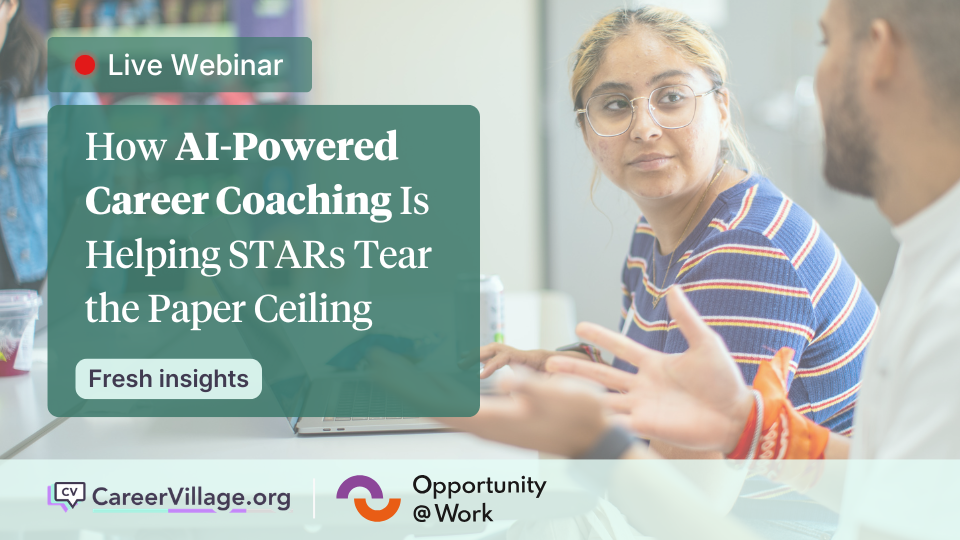
What role can emerging technology play in helping more #STARs translate inspiration into concrete career plans? Join us on Thursday, February 26, for a conversation exploring how AI-enabled career navigation can help STARs navigate job transitions, translate their skills and experience into new roles, and find new employment opportunities. Featuring Charla Bennaji (CareerVillage.org), Natalia Lara (Opportunity@Work), and Ebony D. Thomas (Grads of Life).
Congratulations to our scholarship winners
Congratulations to students Yasmin, Christen, and Emerson, the latest winners of CareerVillage and Coach scholarships! We’re excited to see what awesome things you accomplish as you move forward in your education and into your careers!
What I’m reading
Gen Z Gets Career Guidance on Social Media, Jobs for the Future
Missed this somehow when it first came out in November. Gen Z uses social media (particularly Reddit, YouTube, and TikTok) for career guidance. Mostly, it seems, from each other. In some ways, this seems good; in other ways, not so good.BLS employment report for January, Bureau of Labor Statistics
The US added 130,000 jobs in January, a much stronger showing than expected, although if recent trends hold, this number will probably be revised downward over time. Seems like healthcare hiring is propping up the labor market!AI Policy Atlas, University of Illinois
An easy-to-use new AI policy tracker out of the University of Illinois. Tracks policy by year, state, and bill type. Only nine states, according to this tracker, have passed legislation around AI in education.
Thanks for reading 👋
– Eric Fershtman, Marketing & Communications Lead
To get Career Futures in your inbox, sign up here.