
The confusing, fragmented navigation layer for the trades (January 2026)
Sign up here to get Career Futures in your inbox.
Happy New Year, and welcome to the January edition of the Career Futures newsletter.
The confusing, fragmented navigation layer for the trades
“Learn a trade” has become a kind of all-purpose response to career anxiety.
Worried about the return on investment of college? Learn a trade.
Concerned about AI disrupting knowledge work? Learn a trade.
Struggling to find stable employment? Learn a trade.
It makes sense. While AI hasn’t yet proved to be the driver of mass displacement many of us feared, it is moving into workplaces faster than the Internet did, and there are real signs that it’s reducing demand and changing the nature of entry-level knowledge work. On the other hand, many trade occupations, particularly those involving physical work in unstructured environments, are less exposed to near-term AI-driven automation. Federal labor projections also suggest that demand for many skilled trades is likely to remain steady over the coming decade, driven in large part by retirements and ongoing infrastructure needs. Additionally, lots of trade programs, vocational schools, and unions provide on-the-job training (and may even pay you for it!).
So: learn a trade?
The hidden complexity
Well, which one? The advice conceals an enormous amount of variation and complexity. Say you decide you want to be a mechanic. Great! What kind? There are auto mechanics, aviation mechanics, marine mechanics, heavy equipment mechanics, and many more. The pathways for each are different. The timelines are different. The certifications are different. The safety liability you assume is different. The pay is (often dramatically) different.
Even within an occupation, pathways could look very different depending on where you live. Becoming an auto mechanic in Oregon is different than becoming one in California. In both, you’ll probably need Automotive Service Excellence (ASE) certifications to be marketable (although it’s not strictly required), but California also administers specialty credentials focused on safety and emissions; depending on your role (because auto mechanic, as an occupation, is actually more of an umbrella term comprising multiple ‘technician’ and ‘specialist’ role types and levels), these may be required. Location matters in other ways, too: the expertise a mechanic needs in Phoenix is different from what’s needed in Buffalo. Vehicle brand matters. Dealerships typically pay better than independent shops, and they often have their own credentialing regimes.
Not all trades are equally hard to navigate
What we casually refer to as “the trades” actually contains many dozens of distinct occupations, each with its own rules, risks, and rewards. Lists of trade careers quickly run long: yes, you’ve got your electricians, your plumbers, and your HVAC technicians, but also your wind turbine techs, your riggers, your millwrights, your toolmakers, your elevator installers, your rock splitters, your glaziers…and so on. (At CareerVillage.org, we get a lot more questions about welding careers from students than you’d expect.)
The opacity varies: some trades are more legible from the outside than others. But the cross-trade exploration problem is universal. Even if you could easily research, say, pathways to becoming an electrician, that doesn't help you compare it to HVAC or pipefitting in any structured way.
The asymmetry
Such complexity would be manageable if the system absorbed some of the uncertainty involved in choosing among these paths. But this is where a crucial asymmetry emerges.
The truth is, both college-to-career and trades-to-career can be confusing. Networks matter in both. Outcomes vary in both.
The difference is that higher education, for all its flaws, provides a more standardized navigation scaffold: clear “front doors” (admissions, financial aid), widely understood credential categories, and built-in opportunities to sample options before locking in (intro courses, elective space, transfer pathways).
In contrast, for many trade pathways, the fork comes earlier, and the information is thinner. Comparing HVAC to electrical to pipefitting often requires committing to a program, an employer, or an apprenticeship pipeline before you’ve had a structured way to see what daily work looks like, what advancement paths exist locally, or what switching costs will be if you change your mind.
There is a counterargument here that goes something like: isn't early specialization a feature, not a bug? Isn't it better to start earning and building skills at 19 than to spend four years in college? The answer is: Maybe! But early commitment is probably much more valuable and sustainable if it’s informed.
The navigation ‘cliff’ after high school
High school CTE programs are real and valuable. Across the country, students can get meaningful exposure to trades through partnerships with regional hubs like BOCES in New York or ROP in California. These programs introduce young people to skilled work, help them discover aptitudes they might not have known they had, and can provide a genuine head start on a career pathway.
But there's a cliff. Once you're out of high school, the infrastructure for exploring trades recedes into a confusing, fragmented landscape of options. Community colleges offer some programs. So do nonprofits, unions, and employers. Each has its own entry requirements, its own timeline, its own credentialing regime, and each can only help you navigate what's inside its walls.
Who the current system serves, and who it doesn’t
To be clear: the current system works for some people. If you have family in a trade, or a union connection, or a strong local network, you can get guidance that no website will replicate. The issue isn’t that informal systems are bad. It’s that they're unevenly distributed. The navigation gap is widest for outsiders, like first-generation students, career changers, and people without geographic or social proximity to the trades they're curious about. The 19-year-old who's been working retail and is now curious about skilled trades faces a navigation problem with no clear answer. They're on their own: researching online, piecing together information from YouTube videos and Reddit (or CareerVillage!) threads and AI chatbots, trying to compare options with no structured way to see across them.
What would a real navigation layer look like
So that's the asymmetry: there’s no shortage of options, but there’s not enough legibility. The challenge is in building systems that help people find their way to the right trade, at the right time, with enough information to make a decision they won't regret.
So what would that look like? A few components to consider: a way to see across pathways before committing (something like a ‘common app’ for trades or structured exploration programs for adults), widely accessible counseling that isn't tied to a single institution’s offerings, portable credentials that reduce the cost of switching (although I will note that portability comes with its own set of challenges – more on that in a later issue), and better labor market information so people can see what different paths actually lead to in their region. None of this is easy, and some fragmentation is probably inevitable. But the goal isn’t perfect legibility. It’s raising the floor: making sure that someone without insider connections can at least see the options clearly.
There are early signs of movement. In places like Colorado and a handful of other states, policymakers are beginning to focus less on creating new pathways and more on making existing ones legible: consolidating education and workforce functions, building public-facing platforms that connect jobs, training, and support services (see Alabama, Arkansas, Washington), and piloting forms of career advising that follow people beyond school and into early work and training decisions. None of this yet adds up to a cohesive navigation system. But it reflects a growing recognition of the same problem: telling people to “learn a trade” isn’t enough if we don’t also help them choose one well.
What’s new with Coach and CareerVillage.org
Coach gets a number of usability and reliability updates
Last month’s update to our career coaching platform featured a number of improvements for partners and users, including security and privacy upgrades that align the platform with GDPR requirements (a big deal!), a much more robust reporting experience for advisors using the platform with learners, and a number of small UX and memory improvements for all users.
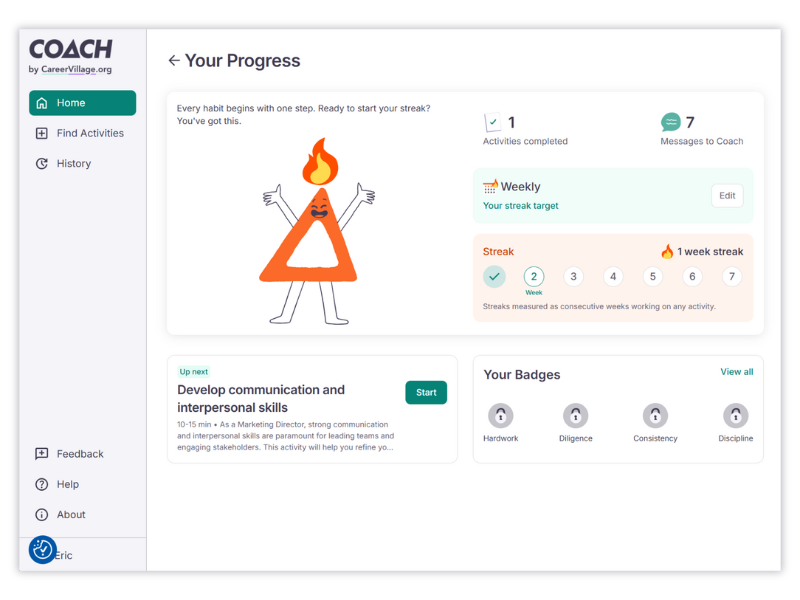
This month, the platform experience for learners is taking another big leap: we’re introducing pathway and goal-setting tools that enable users to set and edit specific career goals. We’ve also added some light-touch gamification elements, such as badges and streaks, to encourage more sustained engagement.
Built for learning: case studies on building impactful AI tools for education
We’re excited to see Bellwether's Built for Learning report finally out in the wild! The team there, especially Marisa Mission, Michelle Croft, and Amy Chen Kulesa, has done impressive work in building detailed, useful case studies of five AI education solutions (including Coach!) and synthesizing varying approaches and lessons learned into a larger report. It’s very, very hard to build AI tools for education that are thoughtful, responsible, and impactful, and all of us in this space will benefit from the learnings documented here.
Bellwether is hosting a virtual panel to discuss these learnings on February 3rd. CareerVillage CEO Jared Chung will be in conversation with leaders from DREAM and Timely. Register here.
What I’m reading
American Exceptionalism and Nondegree Credentials, Work Shift
Interesting comparison between the way Europe and America are handling the quickly emerging ecosystem of non-degree credentials.Is AI responsible for the rise in entry-level unemployment? Revelio Labs
More compelling data that AI is, in fact, impacting entry-level knowledge work. Uses regression analysis to isolate AI’s impact from other macroeconomic factors.The Iceberg Index: Measuring Skills-centered Exposure in the AI Economy
Research examining occupational exposure to AI. A little geeky, maybe, but we’re doing some work related to AI exposure and resilience, and the way the researchers handle this is fascinating, involving a supercomputer and trillions of data points!
Thanks for reading 👋
– Eric Fershtman, Marketing & Communications Lead
To get Career Futures in your inbox, sign up here.